Tag Archives: Christmas

“Bad Santas…” Advent Calendar – December 3 – “The Boy Bishop”

boy bishop - salisbury

All across western Europe, cathedrals would elect a boy bishop. His role was pretty much exactly what the name suggests. He was a pubescent choirboy who was elected at the beginning of December and then dressed in full bishop’s robes, mitre and crosier. He acted as the head of the Church from 6 December until 28 December. He performed the role of a priest, took all services apart from Mass and was free to direct church proceedings and appoint other choristers to act as his canons. The boy bishop was not universally popular – largely because traditionalists felt that the practice of having a small boy pretend to be a bishop undermined the solemnity of the Church.

There were practical problems too. The congregation did not seem to take the boy bishop very seriously and members of the congregation would throw things at him or pull pranks to disrupt the services. Occasionally the boy bishops took themselves far too seriously and houses near the church would suddenly be confronted with a menacing gang of choirboys dressed as bishops and canons demanding the householders hand over money to absolve their sins!

“Bad Santas and Other Creepy Christmas Characters” by Paul Hawkins is available now and published by Simon & Schuster.

Image taken from http://chrismologist.blogspot.co.uk/2011/04/saint-nicholas-and-boy-bishops-of.html

Leave a comment

Filed under Bad Santas Advent Calendar

“Bad Santas…” Advent Calendar – December 2: The Kallikantzaroi

Kallikazantoroi


In Greece those twelve days of Christmas are also the time of the Kallikantzoroi.   The Kallikantzoroi spent the rest of the year underground and Greek tradition went that there was a tree of life that ran right through the Earth and acted as a scaffold to hold it in place. Without the tree, the Earth would simply collapse in on itself. The Kallikantzoroi are quite keen on world destruction and spend January to December sawing through the tree, hoping to snap it in half and bring down the Earth. By the end of the year only the slenderest of threads holds the tree together and the world is set to end at any second. But, just as the Kallikantzoroi are about to make the final cut, Christmas arrives and they are summoned above ground. By the time they return in early January, the tree has regrown and they have to start all over again.

Overground, their actions are sometimes mischievous – they play pranks, steal things or sow discord amongst communities. Other times they might overturn furniture and destroy possessions or they might move on to the inhabitants – beating people savagely or even aping Perchta and ripping out intestines.

What’s more, parents knew that any baby born over the twelve days of Christmas might be spirited away during the night and fated to spend eternity as one of these strange, sinister creatures (or at least turning into one for twelve nights each year).   Binding newborn babies with tresses of straw and garlic would ensure the creatures could not get near them.

But how did you stop a Kallikantzoroi from getting near your house in the first place?  One thing the Kallikantzoroi could not do was to count beyond two – the number three was seen as a holy number by the Greeks.  The creatures would count ‘one, two’ and get confused, lose count and have to start again. The Kallikantzoroi were easy to trick by simply placing a colander outside the front door. The creatures would feel compelled to count the holes and, of course, would not be able to do so. Their confusion and failure to count would keep them occupied until sunrise – at which point the household would be safe until darkness fell again.

“Bad Santas and Other Creepy Christmas Characters” is published by Simon & Schuster and available now.

Image by Mel Four.

Leave a comment

Filed under Bad Santas Advent Calendar

“Bad Santas….” Advent Calendar – December 1: Frau Perchta

Frau Perchta

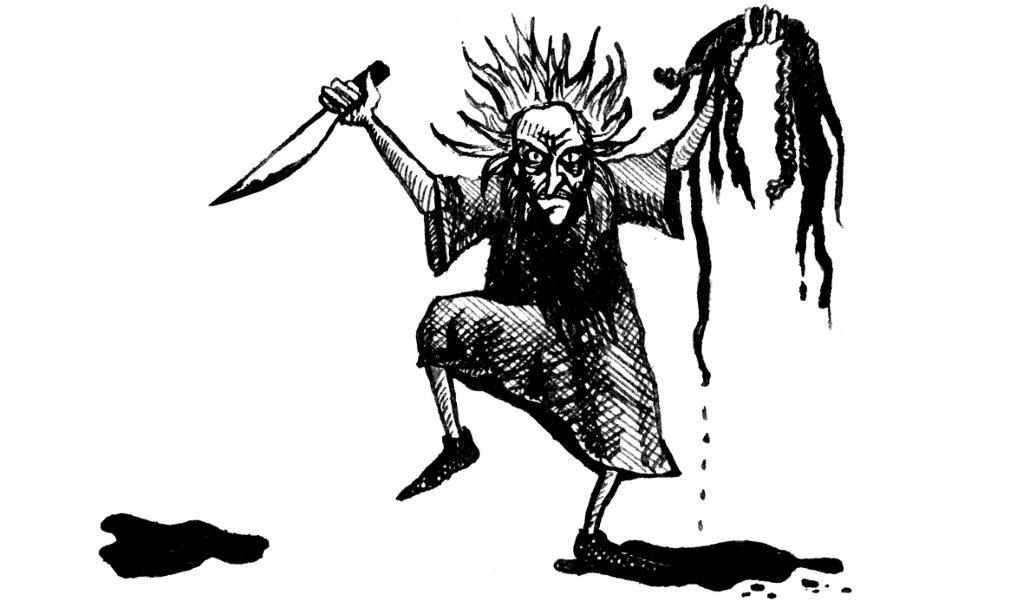
Frau Perchta was a demonic witch who stalked Medievel Central Europe punishing anyone who dared to displease her.

In Tyrol, Frau Perchta appeared as a mischievous, dishevelled old woman. In other places her appearance could depend on how you perceived her and whether you had pleased her. If you were faithful, obedient and observed her rituals, Perchta would appear to you as a staggeringly attractive woman of divine beauty. If you angered her she would appear as a demonic, horned monster with a ferocious bloodlust.

Her most common form of attack was to sneak into your house in the dead of night during the winter and creep up to your room where you were sleeping. The goddess would then take out a knife and, whilst you slept unaware, she would slit your stomach open and remove your innards and your intestines. She’d then replace those innards with pebbles and straw and sew you back up so whoever discovered your corpse the next morning would find absolutely no signs of physical damage. In the days before regular autopsies, nobody would ever prove that you had not simply and peacefully passed away in your sleep.

“Bad Santas and Other Creepy Christmas Characters” by Paul Hawkins is available now and published by Simon & Schuster.

The illustration is by Mel Four and is taken from the book.

6 Comments

Filed under Bad Santas Advent Calendar

“Bad Santas and Other Creepy Christmas Characters” lecture tour.

In December I will be doing a series of lectures in libraries around London to talk about “Bad Santas…”.  Each lecture will be about 45 minutes long and will essentially be a  (hopefully!) amusing and engaging history of how violent, bloody European folk tales of monsters that stalked the winter nights became santised and universalised in the form of Father Christmas.

The dates booked so far are here.   More dates may yet be confirmed.

Friday 6th December – 7pm, Camberwell Library, 17-21 Camberwell Church St, London SE5 8TR

Saturday 7th December – 2pm, Muswell Hill Library, Queens Avenue,
Muswell Hill, 
London, N10 3PE

Monday 9th December – 6:30pm, Maida Vale Library, Sutherland Avenue, London, W9 2QT

Tuesday 10th December – 6pm, Marylebone Library, 109-117 Marylebone Road, London, NW1 5PS

Thursday 12th December – 7pm Canada Water Library, 21 Surrey Quays Rd, London SE16 7AR

Saturday 14th December – afternoon but time tbc, Stroud Green & Harringay Library, Quernmore Road, London, N4 4QR

Monday 16th December – 6.30pm, John Harvard Library, 211 Borough High St, London SE1 1JA

If you’d like to come along then contact the libraries for admission detail.

I’ll also be guesting at the Comedy Club For Kids’ Santa Claus Science Experiment on the 15th and 22nd of December at the Bloomsbury Theatre (tickets available at the above link).  The show also features Darren Hayman, Robin Ince, Tiernan Douieb, Nick Doody and a host of other performers.  Tickets are available from the link above.

If you’d like to contact me about a lecture at an event near you, contact me on paulalexanderhawkins <at> gmail.com

Leave a comment

Filed under Paul Hawkins

Diary of a First-Time Author #6– Approaching an Agent or Publisher

OK.  So you’ve decided you do want to go the industry route.  Now what?  What do you need to approach an agent or publisher?  And how do you approach them?


Before I start, bear in mind this will be one of the longest posts in this blog so far – basically because I hope it’ll be useful and I want to go into a non-fiction proposal it in some detail.  So go and make a cup of tea (leave this screen open so you remember to read this) and then sit back down at your computer and read on…


The approach differs depending on whether your submitting fiction or non-fiction.   Some advice applies to both though.


When making an approach:


  1. Ensure you research who you’re approaching beforehand. Knowing who you are approaching will save you a lot of wasted time and potentially stop you looking very, very silly   Agents’ websites give lists of the agency’s list of clients and publishers’ websites showcase the books they have published in the past.  Sometimes there will even be profiles of individual staff members and their favourite authors and genres.  There is absolutely no excuse failing to check these out.  There is also no more certain route to failure than, say, pitching a deliriously bloody horror story to a publisher of children’s books.


  1. If you can get hold of the publisher or agent’s email address – and the harder it is to get hold of one, the more polite you should be when you approach them –I’d recommend sending short polite email directly to the agent or publisher briefly outlining your project and asking for permission to send them a proposal. Ultimately sending your work into people can be a lot of investment of time, money and effort for a great deal of rejection and failure.  Pitching your project beforehand helps you to establish a relationship with agents or publishers and helps ensure you only send your work in to people who might actually want to read it!


  1. If you do send something in without pitching, I’d write a short covering letter.  It gives you a chance to talk about how you see the project and explain your motives for writing it.  This makes it much easier for someone to give you feedback as they get a picture of what you’re aiming for and, if an agent is impressed by the pitch but not the proposal, could even mean they’re prepared to take you on and help you improve.


It also allows you to talk about how you see your book being pitched and marketed.  Both my publishing editor and my agent clearly utterly love books and are knowledgeable, passionate people but the reality is they are working in a business and it helps them to know that you’re a writer who acknowledges this.  And it’s really good for you to be able to have your say early on what you how you think the book should be perceived and who it’s aimed at.


Fiction


With fiction, you want to include a quick pitch in your original email – this should be no more than a short paragraph (usually the shorter the better) to sell the idea.  Try to make it snappy and capture the essence of what’s unique and interesting about your pitch – basically why is this is a good idea and why are you the best person to write it?


If the person likes that, they’ll probably ask you to send a first chapter – although bear in mind that, in reality, they might only read the first ten pages or so before deciding to pass if they’re not already hooked so a strong start is essential – and possibly a synopsis of the whole plot.  The synopsis would be a few pages and would tell the story of your book, including all the key plot points that are crucial to understanding the story.


Bear in mind that, even though you’re not being asked to send a novel at this point, it’s highly unlikely that anyone will make a decision on whether to go ahead with your work until they’ve read the whole thing – ultimately there’s no other way of telling if you’ve managed to plot and pace it successfully.  For this reason there’s not really a great deal of sense in pitching it until you’ve completed the whole thing.


Non-Fiction


The big advantage of non-fiction is that you can pitch it and sell a proposal before you’ve written the book.  As with fiction, make the pitch in an email and, if they’re interested, send the following:


1)    A short pitch of the book


Basically this should be a bit like the blurb on the back of the book.  Explain what the book is, include a few juicy facts to capture the reader’s attention and try to use the tone you intend to capture in the book.


Above all, remember that you are selling the book – make it appealing.  To give you an idea, here’s what I submitted for Bad Santas:


How did St Nicholas save children from prostitution and cannibalism?  Who were the Yule Lads and why would they lick your saucepans and steal your sausages?  Why was the Alpine Father Christmas accompanied by a demonic figure called the Krampus who bundled children into sacks and dragged them off to Hell?  And why do Spanish nativity scenes often feature a defecating peasant?


Over the course of the 20th Century, a universal image developed around the world of Santa Claus as a seasonal Christmas visitor but, prior to that, each country, each town and each community would have Christmas visitors of their own – sometimes human, sometimes animal, sometimes something else entirely – with their own curious set of mythology and customs.


Some of these were strange; many of them were utterly, utterly terrifying.  Dutch children were as likely to take a beating from the sinister Zwarte Piet as to receive a present whilst the Finnish were visited by a Pagan goat named Joulupukki that was said to eat anyone who misbehaved.  In Iceland, even doing as you were told wasn’t always enough to avoid being eaten –  it was said that any child who did not received an item of new clothing for Christmas would be caught and consumed by a monstrous Christmas Cat.  Even in countries with a figure that resembled the modern Father Christmas, he was not so much a benign charitable figure as a summary judge, jury and executioner testing out children’s knowledge and fidelity to the Bible and dealing out rewards or punishments as he saw fit.  “You’d better watch out, you’d better not cry, you’d better not pout, I’m telling you why” Haven Gillespie wrote in his famous song about Santa Claus and, for much of history, this advice was something which children would cling to preserve their lives.


This book celebrates some of the most imaginative, most terrifying and most outright curious Christmas figures from around the world.  Some of the characters were vicious, such as the Perchta who’d slit your belly open and replace your innards with straw and pebbles if you hadn’t prepared the Christmas decorations.  Others were more mischievous, such as the Karakancolos who’d jump on your back at night and force you to carry him wherever he wanted to go until the break of dawn.  Others still, such as the Spanish Christmas log that children beat with a stick whilst chanting for it to ‘shit them a gift’, are simply outright bizarre.


Bad Santas and other Creepy Christmas Characters is intended to be engaging and blackly comic with a touch of the macabre and aimed at both those interested in folk mythology, the general reader who wants to learn more about the origins of Christmas and people who are looking for an unusual and engaging Christmas gift.


2 A summary of comparative literature


This should be about a page long.  Explain which other books that exist around your subject and a justify why you should write another one – has not enough been written about the subject?  Do you have a unique take on it?  Do you have access to information other writers did not?  Is there a flaw in the existing books you think you can rectify?  Do you think there’s an audience interested in the subject that wouldn’t be reached by other books?


My argument with Bad Santas was that most books about Santa Claus were either aimed for children or academic audiences and there was no book which covered the history of Santa Claus that was aimed at the general reader.


3 About the Author


This is a few paragraphs long and it’s basically who you are, what you’ve done before and why you should write this book.  Again, remember to sell yourself!


4 A provisional list of chapters


Exactly what it says.  This should just be a list of chapter names – try to use names that sound intriguing but give an idea of what will be in the book.


5 Chapter Overview


Go through the chapters one-by-one and write about 300 – 500 words about what will be in each chapter.  It’s okay if you still need to do a bit more research on the book at this point but make sure you’ve done enough to sound like you know your stuff.


6 One or two sample chapters


Choose the most interesting and show off your writing style.  Aim for a total of between 6000 and 10000 words.


Be engaging, be interesting and include enough details to show that you really know what you’re talking about.  Make sure you get someone to check through it for spelling mistakes, boring bits and any flaws or holes in your writing.


Keep in mind throughout you’re trying to demonstrate that you’ve got a strong idea that you can sustain throughout a 50, 000 – 100, 000 word book and that you’ve got the knowledge and enthusiasm to see it through.  It’s worth putting your research in but the good news is that the research and information you put into your chapter overview is going to be a really useful blueprint when you come to write the book!


Once you’re sure it’s all ready and as good as it can possibly be then fire it off to the agent or publisher and then hope and dream about an offer coming in!

Leave a comment

Filed under Diary of a First-Time Author

Diary of a First-Time Writer #3 – A Quick Note on Working for Free

So I’ve talked about doing something to get your work out there and get yourself noticed. One obvious way of doing that is putting your work online and, if you start trying to get your writing published online, sooner or later someone will offer you a chance to contribute to their website – usually there won’t be payment involved but instead it’ll be sold as an opportunity for exposure or to get noticed.

So should you do it?

First off, if you are considering working for free, this website is essential reading

http://www.shouldiworkforfree.com/

Practically speaking, I’d always be cynical of anything that claims to give you “great exposure” or “raise your profile”.   A lot of websites and publications that make such claims do nothing of the sort and the problem is that, once websites realise there’s a market of aspiring writers who are happy to work for free to gain opportunities, any incentive to pay writers to write disappears.  So, rather than improving their chances of getting paid work in the future, writers who work for free actually tend to lessen the amount of paid work around and thus create a situation where nobody gets paid.  Except perhaps the website via their adverts and sponsorship deals.

What’s more, if you want to showcase your writing, it’s really important that you write things that you actually want to write and show what you want to do.  There’s absolutely no point in trying to showcase yourself by writing something that doesn’t play to your strengths.  It’s far better off to create a blog and use that to write things that you really care about.

The other essential thing to realise is that, if you do try to get an agent or sell a book or even a freelance article, you’re going to be judged on what you propose and what you do on that piece of work alone.  Whilst it doesn’t hurt to have some examples of previous work you don’t necessarily need it and, unless your blog or something you’ve written really catches fire on the internet, it’s probably not going to make that much of a difference what websites you’ve written for.  (This is a little bit different if you want to write journalism but I still think a good blog of your own is going to make a greater difference than bits and pieces on other websites.  This can change if you can become the editor of that website of course!)

Which isn’t to say you should never write for free – I’ve written academic articles for books before which I didn’t get paid for but I was interested in subjects in question and it was a chance to see my work published in a book, which was ace.  And, if you write for, say, an online music or film magazine you might get given free stuff to review or the chance to interview people you admire.  So you might be getting something out of it that isn’t actually money.

But you should ask yourself the following questions:

1)    Would you write this anyway?

2)    Is this how you want to come across as a writer?

3)    Is someone making money whilst you’re not?

Having people read your writing is great and there’s obviously something brilliant about people wanting you and wanting to see your work but the bottom line is that anytime you’re not being paid to write then you’re doing it as a hobby rather than work.  So treat it on these terms and make sure you’re enjoying it!

Leave a comment

Filed under Diary of a First-Time Author

Diary of a First-Time Author #2 – Up All Night to Get Lucky…

653_68333611619_5926_n


When people have found out about my book, there’s one question that I’ve been asked time and time again.  Sometimes by someone asking for themselves, sometimes on behalf of a friend but nonetheless the question has been “how did you get an agent?”


It’s a good question because the initial process of getting an agent is possibly the biggest barrier to overcome for an aspiring author and, from the outside, it can seem an insurmountable barrier and, for that reason, I know that when the person asking me is really asking for a formula that they too can follow with guaranteed success.  Which makes it a shame that my answer is both rather mundane and tricky to replicate.  I’d love to be able to tell an inspiring and moving story about how I sent my book to every agent in London, received rejection after rejection and rejection but then, when I was right at my very lowest ebb, an agent finally responded and made my dreams come true.  But that would be a lie.  The simple and most honest answer is that I got an agent through sheer dumb luck.


The day that I decided to write a non-fiction book about Santa Claus, I was feeling quite motivated to get on with things and decided to get on and write a proposal.  The only problem was that I had absolutely no idea what a non-fiction book proposal looked like or involved, or how much of the book I needed to write before submitting it (this is a question I will answer in either the next article or the one after that).  Feeling a bit lazy I decided not to Google it myself but instead posted something on Facebook asking my friends, acquaintances, people I went to school with and the people who I’ve never met but continually send me invites to gigs they’re promoting whether anyone had ever written a non-fiction book proposal and whether they knew what it involved.  I wasn’t expecting much but a friend of mine came back and said that his friend Matthew was a literary agent and would be happy to give me some advice.  I dropped the friend an email asking for help and briefly pitched the idea (“to give him an idea of what I was trying to do”) and got an email back from Matthew saying he liked the idea and wanted to meet me the following week.


I realise that this involves a lot of lucky coincidences.  I happened to know someone who knew an agent, the agent happened to be willing to give some advice to a friend of a friend and the agent then actually liked my idea.  I also realise this is the sort of thing that could make other aspiring writers a bit angry and would (probably rightly) lead you to conclude that it’s not what you know but who you know.  Also it raises the question of why I’m telling you all this and whether there’s a particular lesson that I wish to impart.


The answer to the first question is that I’m telling you this is that it’s because it’d be a bit odd if I wrote about how I came to write the book and didn’t touch on how I came to get an agent.  The answer to the latter question is there are probably two lessons you can take from this that you might find useful.


The first one is to remember that luck will play a huge part in anything that happens to you, for good or ill.  This can be a difficult thing to accept – everyone wants to feel they’re responsible for their successes and we live in a culture where it seems everyone of note – from writers to actors to musicians to businesspeople to sports stars – will continually emphasise how they have succeeded because they worked so hard and ‘wanted it’ so much.  And I’m sure they belief that but nonetheless you’re getting a very skewed picture because newspapers and magazines tend to only interview the rich and famous – you never ever hear from the people who worked hard but didn’t ‘make it’.  Who’s to say how hard they worked and how much they wanted to succeed?  Ultimately you can work as hard as you like but, without the lucky break that gets things moving, it won’t guarantee anything.


So far then, none of this is actually particularly useful and it all probably sounds slightly depressing.  I can only apologise for that.  I’m trying to be truth rather than raise false hopes and this is the precise reason I’ll thankfully never make much of a self-help guru or ‘lifestyle coach’.


Nonetheless there is a more positive side to this that perhaps you can learn something from and that is that I’ve not yet revealed the full picture of how the lucky coincidence that helped me get an agent took place.


I might have got a break through knowing the ‘right’ people but, when I first came to London ten years ago, I barely knew anyone at all.  I grew up in a small village, my family had zero links with the literary industry whatsoever and, when I first moved to London, ten years ago, I had literally one friend in the entire city and for several months I was lonely, shy and probably a bit depressed.  I wrote in the first article about how, as I approached my 30th birthday, I felt I’d wasted my twenties.  But looking back, this wasn’t entirely true.  I actually spent a lot of time putting myself into a position where I knew enough people for coincidences to happen.  I don’t entirely buy into the idea that people ‘make their own luck’ but I do believe it is a simple truth that the more people you befriend, and the more you demonstrate to people what you can do, the more likely it is you’ll find somebody who can help you.


But, short of sitting people down and forcing them to read your book, how do you demonstrate what you can do?  What I did was learn a few simple guitar chords become a musician.  I originally started playing acoustic guitar and singing at open mic nights because I was feeling pretty isolated and wanted something to get me out the house but I realised that, whilst film scripts can take well over a year to write and wind up being read by nobody whatsoever, you can write a song in the morning, perform it to the audience in the evening and receive instant feedback on something you’ve written.


Daunting though it sounds, I would recommend any aspiring writer tries their hand at  performing in public – be it music, poetry, stand-up comedy or even simply delivering talks and lectures.   It’s a chance to see what audiences respond to, when and where you gain and lose audience interest and, because you don’t want to embarrass yourself in public, it really forces you to improve.  I’d also advise, when you’re out at any kind of performance, gauging audience reactions to other people’s work as well. Obviously your ability to go out and perform regularly depends on where you live, your financial situation and your family commitments so I know this may not be advice everyone can follow but, if you can do it, I’d strongly recommend it – I learned more about writing in my first nine months’ of performing than I did in five years of writing in a room on my own.  (If it really isn’t possible, then I’d probably recommend starting a blog and joining internet messageboards related to your interests – it’s not quite as good as meeting people in the flesh but you can nonetheless befriend like-minded people and let them get to know your style of writing).


What’s more, by performing you’ll start to meet people who share your interests and build up the number of people you know – many of whom will work in creative field.  I despite the term ‘networking’ and the idea of anyone cynically going out and meeting people who can advance their career but, if you go out to things you’re interested in and talk to people, you might find it happens anyway.  What’s more, it shows an audience what you can do.  Ultimately I enjoyed the music so much that I ended up with a band, a small record deal and some radio and festival appearances.  Not only was this fun, it was a brilliant way to get people to know about my interests and my style of writing.  Going back to the top, the friend who responded to my Facebook question was someone who’d seen me play several times and liked my style of writing and I later found out one of the reasons why Matthew was interested in taking me on was because he too had heard my music and the dissonance between the blackly comic approach of my song-writing and the fact that I wanted to write a book about Santa was a big part of the appeal.


None of this changes the fact that I succeeded through a series of lucky coincidences but they were lucky coincidences that only happened because I was already going out and working hard to promote myself and my writing without really realising I was doing it.  Luck will play a huge part in whether you succeed or not but I certainly think the writer who goes out and talks to people is far more likely to be lucky than the writer who stays at home and keeps all their work hidden in a drawer.  It might not be fair that we live in a world where who you know matters more than how you write but, if that really is the case, then  – like it or not – the most pragmatic solution is to get out there and meet more people…

1 Comment

Filed under Diary of a First-Time Author

Diary of a First-time Author #1 – How to fail your twenties…

My name is Paul Hawkins and I’m an author.  It feels weird and slightly fraudulent saying that but my first book Bad Santas and other Creepy Christmas Characters is being published by Simon and Schuster on October 22nd.  Since I’ve told people about the book, I’ve had a quite a few questions from friends and friends of friends about how you get published and how the whole process of putting a book out works.  So I thought I’d write a series of articles that’ll hopefully be reasonably engaging and useful and hopefully help people in pursuing their own writing.

Image

First of all though, I’m going to talk about my background and experiences with writing prior to the book and the events that led to me deciding to chance my arm as a non-fiction writer.

I’ve wanted to be a writer ever since I was a teenager.  At the age of 18, I did a degree in Scriptwriting for Film and Television.  Whilst doing the degree I then found out  how much power the producer held over script decisions in film and TV soI did an MA on Producing for Film and TV as well.  I then left University at 22, feeling fully qualified and ready to produce the work that would see me hailed as the brightest young writing talent in the United Kingdom.

Obviously that’s when real-life happened. I spent six months scrabbling about trying to find a job in film and television and working out whether I could afford to do some sort of unpaid internship (I couldn’t – I had bills and rent to pay) before pretty much giving up and letting the temp work I was doing to fund myself gradually become permanent.  But that was okay because I decided I’d write in my spare time, sell a script to get me started and be a full-time writer by the time I’m 25.

Again, that didn’t happen either.  If you’re reading this then you probably already know that trying to write in your spare time is an exhausting process – incidentally this Onion article is one of my favourite things on the internet – and I got a bit lazy and procrastinated.  I started writing less frequently and things got finished less and less often.  Before long my “writing career” pretty much consisted of me meeting up with a couple of friends from my Scriptwriting degree and talking about future project that we never actually seemed to get round to writing.

Before I knew it I was a public sector office worker lurching towards his 30th birthday with no professional skills, no prospects and no job security.  I’d found out my contract was not being renewed due to public sector cuts and applied and failed to get job after job after job after job.  It turned out I had a finely-honed knack for coming second in interviews.  Unless there were two jobs going.  Then I’d finish third.

All of this was really depressing and I began to seriously panic both about my short-term prospects and, more importantly, about the growing realisation I was wasting my entire life.  Miraculously I got a last-minute reprieve in my job, which was equally a blessing and a curse, but knew a second round of cuts was forthcoming so I jumped before I was pushed and applied for a PGCE to teach adult literacy.  (By the way, if you’re worried about a lack of job security, do NOT retrain as an adult education teacher.  It makes managing a football club look like a secure role with long-term prospects.)

By this point any dream I had of being a writer was long-since dead.  Back when I was in danger of losing my job, I remember going to a job interview for some sort of job around public sector pensions and being asked about by Scriptwriting degree and firmly assuring the interviewer that writing was behind me and that I just wanted to get a job where I could work hard and climb the career ladder.  I might have actually even believed that.

But then going back to University awakened something in me.  It reminded me of how much I loved learning, researching and writing essays and it reminded me that I was probably better at that than anything else I’d done in my life.  And eventually I realised I wanted to try to be a writer again – but this time, I had to make it work.

I set myself some ground rules.  The first one was that I was going to be disciplined in how much I wrote and how often.  The second one was that, whilst being sure to write about subjects I was interested in, I was going to be pragmatic about focussing on ideas that I believed had a chance of being published.  Thirdly I decided that, because my essays and dissertations went well and my attempts at fiction tended to fizzle out, I would focus on writing non-fiction.

Years before I’d had a fiction idea around Father Christmas but, try as I might, I could never quite get the story to work.  However I realised I had amassed quite a bit of research around the history of Santa and the different folklore and mythology around the world that had inspired his creation and that, in finding the research, I’d never seen one book that contained all the information I wanted.  I decided on a bit of a whim that I would pull this work together and try to put together a book proposal.

Through sheer luck – I’ll talk more about how to help your chances of being ‘lucky’ in my next article – I found myself an agent and, after a year of revising and knocking things into shape, I found myself in the offices of Simon & Schuster taking to a publishing editor.   Seven months on and the book comes out next month.

It’s an exciting time but also a nervous one.  I really can’t wait for the book to be published but I’m also apprehensive about what people’ll think when they read it and, to be honest, still a bit confused as to what the publishing process actually involves.

Over the next few of these articles I’ll talk a bit more about what approaching agents and publishers and what publishing a book actually involves.  As I get nearer to the publication date I’ll start to write more about the experience of releasing and marketing a book, what actually happens in the build-up to the release and what goes through my head.  I’ll also be very happy to answer any questions readers have and share any advice that I have to offer.

Leave a comment

Filed under Diary of a First-Time Author