Tag Archives: books

“Bad Santas…” Advent Calendar – Day 5: the Krampus

The Krampus

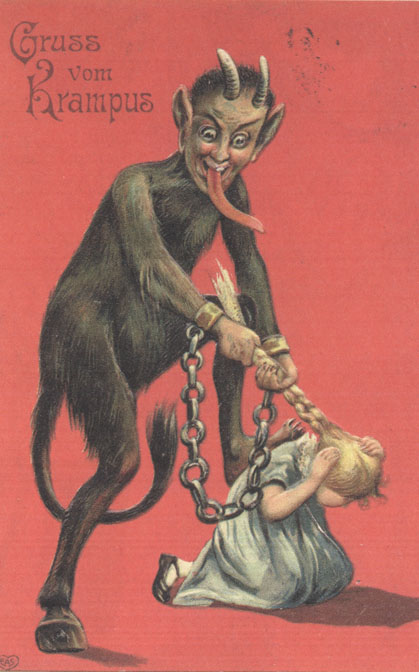
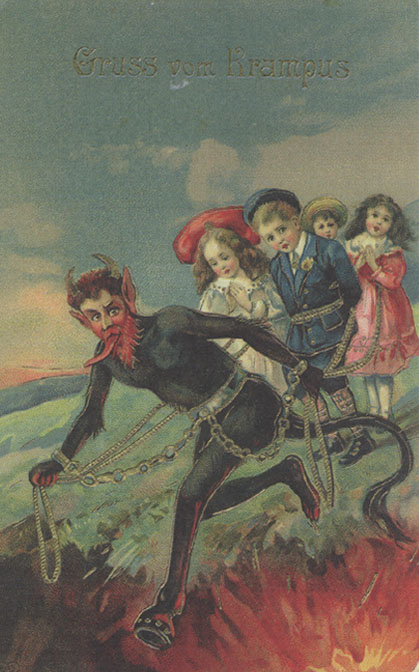
The Krampus is a demonic hell-beast resembling a horrifically mutated goat with a sadistically wide range of punishments and tortures.  He beat children with a birch rod on occasions, but he also had a whole repertoire of penalties that ranged from ripping out a girl’s pigtails to leading children off cliffs Pied Piper-style or tossing children onto a train that was on a one-way journey to a lake of fire. He especially enjoyed eating naughty children for Christmas dinner and he’d even carry a bathtub on his back just in case the mood took him to drown a child in a bathful of water – or sometimes ink – before fishing them out with his pitchfork to eat.

5 December was not only St Nicholas’s Eve but it was also Krampusnacht – the night when the Krampus was free to roam the Alpine streets, heading from house to house to demand tribute, often in the form of alcohol.  The Krampusse in question were really large groups of young men dressed up in self-made costumes of fur, masks and goats’ horns charging around the streets with birch rods and pitchforks getting increasingly drunk, accusing people they encounter of misbehaviour and threatening to beat them up as punishment. Genuine monsters from the fires of Hell would probably have caused less destruction.

Whilst many of these other Christmas characters peaked during the fifteenth and sixteenth centuries, interest in and enthusiasm for the Krampus seems to have grown over time and the Krampusnacht remains popular today.  The nineteenth-century invention of Christmas cards saw an explosion of Christmas images of the Krampus sent around the world. The images were generally intended to be comical and something about the mischievousness and malevolence of the character clearly appealed, for Krampus cards were extremely popular. One card shows him grabbing a girl by the pigtails trying to pull her hair out.  Another sees him in a motor car stealing children.  In yet another card he is dragging a group of children off the edge of a cliff, beating children or driving off in a cart with a child in a sack on his back. Yet another card shows a group of children opening a box wrapped with shiny Christmas paper only to find the Krampus hiding inside waiting for them.

Devil_55Devil_109Devil_11

Some of the cards have a clear sexual twist. The Krampus is sometimes seen romancing attractive ladies and a couple of cards even show gigantic female Krampusse – far more woman than Krampus – chasing after adult men or carrying them away in her sack. This sexual theme for the Krampus would expand hugely after the sexual liberation in the 1960s, when cards often showed the fierce demonic figure invading the bedrooms of scantily clad women to beat them with his birch rod.

$(KGrHqVHJFQFIhlF0332BSPOfglWWw~~60_12

For the most part, however, the Krampus remains a source of terror.  The Krampusnacht continues today and is as popular as ever and, whilst it is slightly more sanitised than its anarchic Medieval peak, it still makes for a surreal and terrifying experience.

Visit here for some more absolutely incredible Krampus images.*

“Bad Santas and Other Creepy Christmas” by Paul Hawkins is published by Simon & Schuster and out now.  The Krampus image in the picture is by Mel Four and taken from the book.  The other Krampus pictures are from vintagepostcards and are mostly taken from Krampus.com

*(genuinely – it’s a link to the Atlantic and not affiliated to me in anyway!)

Leave a comment

Filed under Uncategorized

Diary of a First-Time Author #10 – How To To Write a Book

So you’ve sold your proposal, you’ve got the first part of your advance and now you actually need to write a book.  Someone’s actually given you money to be a writer and they’re expecting you to deliver.  It’s utterly, utterly brilliant and utterly, utterly, utterly terrifying.


With Bad Santas, I had the added pressure of the fact it was a Christmas release and so, having met the publisher and received the offer in February and signed the contract at the beginning of April, the book had to be ready by the end of May.  Which was a bit intense.  Luckily I started writing from the February of else it probably would have been impossible!


So how do you do it?


  1. Plan how much you need to write


Work out the exact number of words you need to write and when your deadline is.  Divide it by the number of weeks and then by the number of days you intend to work.  You then have your target number of words per day.


  1. Plan for Contingency


Now ignore this figure.  Instead work out the exact number of words you need to write to get the book finished four weeks before the deadline.  Aim for that target instead.  Then you’ve got a whole month to cover you for illness, parts of the book taking longer than you anticipate, rewriting days and things like that.  Also add another 15, 000 words to your word total to cover all the things you write that either ultimately don’t fit in with the book or aren’t good enough to use.  Do the maths again.  Now you’ve got your real target number of words per day.  Try not to panic when you look at it.


  1. Plan what you’re writing


If you got the pitching document I discussed in article #3 right then it will now be your best friend.  If not you really need to structure out each chapter and make sure you have a blueprint of exactly where you’re going – it’ll save you a lot of wasted time and energy as you go through the book


  1. Work out your writing routine


Be realistic about how much time you have, especially if you’re not able to take time off work to be a writer.  I was lucky enough to take a break to write the book but I’m now sat on the top deck of a bus typing into my laptop as I take the 43 from Muswell Hill to London Bridge on my way into work.  This gives me an hour to an hour and a half’s writing time per day.  It’s not ideal but, as I’m not writing any specific project at the moment, it could be far worse.


Also, think about the way that you work and try to work with that, rather than against it.  For example, I’m a procrastinator who gets occasional bursts of focus – typically first thing in the morning, shortly before lunch and then for a couple of hours in the late afternoon and early evening.  When I was writing Bad Santas, I tried to structure myself around that.  On an ideal day I’d get up about 7 or 8 o’clock, do an hour to an hour and half of work (usually revisions and re-writes from the previous day), then take a shower, a short bus-ride to somewhere scenic and from there take an hour and half long walk to the British library (walking really helps me both relax and to think about what I’m doing).  I’d then do about an hour’s work before breaking for lunch, spend most of the afternoon recovering from the lunch break and then do a concentrated burst of writing between 4pm and 7pm before going home.


Obviously I’m not suggesting that that’s the best way to write but it is the best way to write for me.  As far as is reasonable around your life commitments, it’s a good idea to think about what works for you and stick to it – there’s no point in chastising yourself but not being sat in your writing chair at 9am if you find it easier to write in the night-time.


  1. Be disciplined


At the same time, it’s really important to be disciplined.  Whilst writing is a million times better than a real job, you still get days where you really don’t want to get out of bed, sections of the book you dread writing and times when you lack all motivation and just want to pack up and go home (unless you’re working from home, in which case you want to pack up and go out somewhere instead!)   And, if you’re writing a 60, 000 word book, there’ll be times when you find yourself utterly bogged down in the middle somewhere, unable to see the end and feeling like you can’t possibly process, let alone write down, everything you need to say.  But ultimately, if you’re going to finish the book, you have to keep going.


Whilst writing the book I worked out that I could write approximately 2, 000 ‘useful’ words a day.  Any less and I was being unproductive, any more and the quality really tailed off.  So I set that as a target made sure I ended even the ‘bad’ days with 2000 more words on the page.  Obviously quite a lot of those words needed rewriting later but I find re-writing much easier than writing.  Once you’ve got something down, you can then work out how to get it right…


  1. Make sure you do something tanigble, even if it’s not what you originally planned.


Nonetheless there will be days where you really find you absolutely cannot face doing the part of the book that you were ‘supposed’ to be doing that day.  If you really can’t discipline yourself to do it then the simple solution is to do something else instead.  Revise and rewrite previous chapters or leap forward and write another part of the book which sounds a bit more interesting.  But try to always go to bed feeling you can see what you’ve achieved.


  1. Re-write continually.


You’re first draft of anything will not be your best piece of work and you should always go through and see what you can do better.  The only exception to that is when you really want to give the impression that it’s just you’re unfettered thoughts spilling out onto the page.  Which is my excuse for ignoring my own advice on these articles.  But otherwise re-writing is key.


  1. Proofread.  Or better still, get someone else to do it.


I am the world’s worst proofreader – as anyone who has read this will probably attest.  My grammar and spelling are fine but I tend to type really quickly and think even quicker, as a result of which what I type tends to be the train of the inner monologue in my head.  This can easily end up like one of those teletext subtitles pages where things are written down phonetically at speed and ludicrous spelling mistakes ensue.  Unfortunately I also read really quickly and, as a result, tend to see what I think is on the page and fail to pick up my own mistakes.


Ultimately the publisher will have their own proofreader but it looks awful if you hand in something riddled with errors and I dimly recall that there are psychological studies that show that the more spelling and grammar mistakes there are in a piece of writing, the less plausible people find the argument.  So it does matter that you get it right before submitting it.


Bear in mind this is really a case of “do what I say and not what I do” here and an area where I’m incredibly sloppy – luckily my parents and friends helped proofread the book for me but these articles are far more exposed and I’m sure my laziness in this respect has come clear several times already!


Ultimately writing is hard work (or at least it can be) and the key to finishing a book successfully is sticking with it even when you utterly hate doing it.  There are thousands – perhaps even millions – of people who’ve half-written books that they’ll never finish.  Becoming one of the few that actually finish things is a crucial part of succeeding as a writer.

Leave a comment

Filed under Diary of a First-Time Author

Diary of a First-Time Author #7 – “And now we play the waiting game…”

“Aaah, the waiting game sucks.  Let’s play Hungry, Hungry Hippos” – Homer J Simpson

So let’s say you’ve submitted your proposal – or manuscript but I’m sticking with the idea we’re dealing with non-fiction for now – to an agent and the agent likes it.  They’ll probably ask to meet you and, if it all goes well, they’ll hopefully offer you a contract.


I won’t go into that contract too much – though I will talk a bit more about the publishing contract later – but the important thing is your agent will get paid via a commission on your earnings.  This generally around 15% + VAT  (i.e. 18.5%) of your earnings in the UK and 20% of your earnings abroad.  There are two good things about this


a) You don’t need to pay an agent anything unless you earn money, which means that, aside from the possibility of the agent not managing to sell your work which means there’s no risk of actual financial loss.  (If you do come across an agent or publisher who wants money up-front or to ‘split production costs’, alarm bells should be ringing very, very loudly.


b) Your agent needs to sell your work in order to make any money.  If nothing else, this should be a big boost to your confidence – an agent would not be spending time working with you unless they expect to make you both money as a result!  It also means that you can be confident your agent is motivated to get you a very good deal because it’s in their interest to do so!


Your agent will so ask you to indemnify them against any potential lawsuits for copyright infringement (which is to say that, if you plagiarise someone’s work, it’s you rather than the agent who will carry the cost for that).  This is a standard clause though it can be very scary to read!


I would also expect the agent to suggest some re-writes.  Of course, I appreciate that you are an artist and your book is your baby and that it’s a violation of your principles to start butchering your masterpiece in order to sate commercial needs.  However I would advise you to be open and consider every suggestion very carefully, whether its from an agent, publisher, proofreader or whoever.


If you do, I suspect you’ll find that – in the vast majority of cases – they have identified a genuine problem or weakness, even if the solution they suggest is not the one you would have gone with.  In these circumstances, I’d always suggest changing it to your option and then emailing back explaining your reasoning.  If you genuinely believe that their suggestion is outright wrong and nothing needs to be changed, I’d again draft an email explaining that but – before sending – I’d then read that email again (perhaps a few hours later or the following day) and make sure your reason is genuinely a really good one.  But the important thing is never ever kid yourself that you’re a genius whose work can’t possibly improved.  Personally I suspect that a lot of times, when a writer or film director gains critical acclaim through brilliant early work but then peters out into mediocrity or worse, then it’s often because they’ve stopped listening to the voices telling them how to make things better…


But anyway, let’s suppose you do your re-writes and the agent is happy and starts to send the proposal to publishers.  At this point, what should you expect?


Probably, in reality, a period of extended silence punctuated by the odd emailed update from the agent.  Perhaps you’ll get an email saying a publisher has shown an initial interest and wants to see the proposal.  Perhaps you’ll then get another email a few weeks later saying the publisher has decided not to take it any further.  Don’t get too downhearted by this – bear in mind that, at this point, there’s money involved and reasons for people not taking a book can be as much to do with what the publishers think they can successfully sell as much as questions of quality.


Nonetheless it can be disheartening and the wait can seem endless.  But hopefully, before too long, you’ll get the message that a publisher is interested and wants to meet you.  This is where things start to get interesting…

Leave a comment

Filed under Diary of a First-Time Author

Diary of a First-Time Author #6– Approaching an Agent or Publisher

OK.  So you’ve decided you do want to go the industry route.  Now what?  What do you need to approach an agent or publisher?  And how do you approach them?


Before I start, bear in mind this will be one of the longest posts in this blog so far – basically because I hope it’ll be useful and I want to go into a non-fiction proposal it in some detail.  So go and make a cup of tea (leave this screen open so you remember to read this) and then sit back down at your computer and read on…


The approach differs depending on whether your submitting fiction or non-fiction.   Some advice applies to both though.


When making an approach:


  1. Ensure you research who you’re approaching beforehand. Knowing who you are approaching will save you a lot of wasted time and potentially stop you looking very, very silly   Agents’ websites give lists of the agency’s list of clients and publishers’ websites showcase the books they have published in the past.  Sometimes there will even be profiles of individual staff members and their favourite authors and genres.  There is absolutely no excuse failing to check these out.  There is also no more certain route to failure than, say, pitching a deliriously bloody horror story to a publisher of children’s books.


  1. If you can get hold of the publisher or agent’s email address – and the harder it is to get hold of one, the more polite you should be when you approach them –I’d recommend sending short polite email directly to the agent or publisher briefly outlining your project and asking for permission to send them a proposal. Ultimately sending your work into people can be a lot of investment of time, money and effort for a great deal of rejection and failure.  Pitching your project beforehand helps you to establish a relationship with agents or publishers and helps ensure you only send your work in to people who might actually want to read it!


  1. If you do send something in without pitching, I’d write a short covering letter.  It gives you a chance to talk about how you see the project and explain your motives for writing it.  This makes it much easier for someone to give you feedback as they get a picture of what you’re aiming for and, if an agent is impressed by the pitch but not the proposal, could even mean they’re prepared to take you on and help you improve.


It also allows you to talk about how you see your book being pitched and marketed.  Both my publishing editor and my agent clearly utterly love books and are knowledgeable, passionate people but the reality is they are working in a business and it helps them to know that you’re a writer who acknowledges this.  And it’s really good for you to be able to have your say early on what you how you think the book should be perceived and who it’s aimed at.


Fiction


With fiction, you want to include a quick pitch in your original email – this should be no more than a short paragraph (usually the shorter the better) to sell the idea.  Try to make it snappy and capture the essence of what’s unique and interesting about your pitch – basically why is this is a good idea and why are you the best person to write it?


If the person likes that, they’ll probably ask you to send a first chapter – although bear in mind that, in reality, they might only read the first ten pages or so before deciding to pass if they’re not already hooked so a strong start is essential – and possibly a synopsis of the whole plot.  The synopsis would be a few pages and would tell the story of your book, including all the key plot points that are crucial to understanding the story.


Bear in mind that, even though you’re not being asked to send a novel at this point, it’s highly unlikely that anyone will make a decision on whether to go ahead with your work until they’ve read the whole thing – ultimately there’s no other way of telling if you’ve managed to plot and pace it successfully.  For this reason there’s not really a great deal of sense in pitching it until you’ve completed the whole thing.


Non-Fiction


The big advantage of non-fiction is that you can pitch it and sell a proposal before you’ve written the book.  As with fiction, make the pitch in an email and, if they’re interested, send the following:


1)    A short pitch of the book


Basically this should be a bit like the blurb on the back of the book.  Explain what the book is, include a few juicy facts to capture the reader’s attention and try to use the tone you intend to capture in the book.


Above all, remember that you are selling the book – make it appealing.  To give you an idea, here’s what I submitted for Bad Santas:


How did St Nicholas save children from prostitution and cannibalism?  Who were the Yule Lads and why would they lick your saucepans and steal your sausages?  Why was the Alpine Father Christmas accompanied by a demonic figure called the Krampus who bundled children into sacks and dragged them off to Hell?  And why do Spanish nativity scenes often feature a defecating peasant?


Over the course of the 20th Century, a universal image developed around the world of Santa Claus as a seasonal Christmas visitor but, prior to that, each country, each town and each community would have Christmas visitors of their own – sometimes human, sometimes animal, sometimes something else entirely – with their own curious set of mythology and customs.


Some of these were strange; many of them were utterly, utterly terrifying.  Dutch children were as likely to take a beating from the sinister Zwarte Piet as to receive a present whilst the Finnish were visited by a Pagan goat named Joulupukki that was said to eat anyone who misbehaved.  In Iceland, even doing as you were told wasn’t always enough to avoid being eaten –  it was said that any child who did not received an item of new clothing for Christmas would be caught and consumed by a monstrous Christmas Cat.  Even in countries with a figure that resembled the modern Father Christmas, he was not so much a benign charitable figure as a summary judge, jury and executioner testing out children’s knowledge and fidelity to the Bible and dealing out rewards or punishments as he saw fit.  “You’d better watch out, you’d better not cry, you’d better not pout, I’m telling you why” Haven Gillespie wrote in his famous song about Santa Claus and, for much of history, this advice was something which children would cling to preserve their lives.


This book celebrates some of the most imaginative, most terrifying and most outright curious Christmas figures from around the world.  Some of the characters were vicious, such as the Perchta who’d slit your belly open and replace your innards with straw and pebbles if you hadn’t prepared the Christmas decorations.  Others were more mischievous, such as the Karakancolos who’d jump on your back at night and force you to carry him wherever he wanted to go until the break of dawn.  Others still, such as the Spanish Christmas log that children beat with a stick whilst chanting for it to ‘shit them a gift’, are simply outright bizarre.


Bad Santas and other Creepy Christmas Characters is intended to be engaging and blackly comic with a touch of the macabre and aimed at both those interested in folk mythology, the general reader who wants to learn more about the origins of Christmas and people who are looking for an unusual and engaging Christmas gift.


2 A summary of comparative literature


This should be about a page long.  Explain which other books that exist around your subject and a justify why you should write another one – has not enough been written about the subject?  Do you have a unique take on it?  Do you have access to information other writers did not?  Is there a flaw in the existing books you think you can rectify?  Do you think there’s an audience interested in the subject that wouldn’t be reached by other books?


My argument with Bad Santas was that most books about Santa Claus were either aimed for children or academic audiences and there was no book which covered the history of Santa Claus that was aimed at the general reader.


3 About the Author


This is a few paragraphs long and it’s basically who you are, what you’ve done before and why you should write this book.  Again, remember to sell yourself!


4 A provisional list of chapters


Exactly what it says.  This should just be a list of chapter names – try to use names that sound intriguing but give an idea of what will be in the book.


5 Chapter Overview


Go through the chapters one-by-one and write about 300 – 500 words about what will be in each chapter.  It’s okay if you still need to do a bit more research on the book at this point but make sure you’ve done enough to sound like you know your stuff.


6 One or two sample chapters


Choose the most interesting and show off your writing style.  Aim for a total of between 6000 and 10000 words.


Be engaging, be interesting and include enough details to show that you really know what you’re talking about.  Make sure you get someone to check through it for spelling mistakes, boring bits and any flaws or holes in your writing.


Keep in mind throughout you’re trying to demonstrate that you’ve got a strong idea that you can sustain throughout a 50, 000 – 100, 000 word book and that you’ve got the knowledge and enthusiasm to see it through.  It’s worth putting your research in but the good news is that the research and information you put into your chapter overview is going to be a really useful blueprint when you come to write the book!


Once you’re sure it’s all ready and as good as it can possibly be then fire it off to the agent or publisher and then hope and dream about an offer coming in!

Leave a comment

Filed under Diary of a First-Time Author

Diary of a First-Time Author #5 – But what about self-publishing?

I’m aware that my last piece rests on the assumption that you are looking for a publisher to publish your work. Some would argue that, in the age of self-publishing, this is no longer necessary.  Can you not just publish yourself and skip this entire hassle of jumping through hoops to get an agent or publisher to like your work?

Possibly.  It’s not an avenue I explored personally (for reasons that’ll become clear as you read this), and I won’t pretend to be a self-publishing guru, but I do think there are certain things to bear in mind before considering the self-publishing route.

Self-publishing is, in theory, a great thing.  It opens up chances for writers who choose to work outside the publishing industry, allows  writers more control over their work and, especially if you’re a hobbyist writer who just wants to make something available for people to read without the stress and the hassle of finding a publisher, there’s certainly some merit in that.  And anything that makes it easier for a new writer to get their work to an audience has to be welcomed.

If you’re self-publishing in the hope of ultimately making a living as a writer, I feel there are a few things to bear in mind.

Firstly, self-publishing tends to work best for people who work within specific genres – wonderful though the internet is for getting your work out there, it still needs people to search for it and find it and they’ll mostly do that by searching by genre or by “people who liked this also like this” recommendations.  So, if you write a strong crime novel or romance and enough people like it, then there’s a good chance other people searching for crime novels or romances will find it too.  However if you’re writing something that doesn’t fit in with what anyone else is writing, you’ll find it much harder to garner attention.  (The flip side of this, of course, is that you can also succeed by writing a book that is so niche that people looking for a book on a subject will only find yours!)  One of the things that large publishing houses can do – and often will do – is take a book that might have otherwise struggled to find an audience due to its subject matter and turn it into a hit once people realise how good it is.  I find it hard to imagine The Curious Incident of the Dog in the Night-Time, The Life of Pi or The Kite Runner, for example, would have garnered a huge amount of attention had they been self-published.

What’s more, it’s important to realise that self-publishing doesn’t remove the business and publicity aspect from you’re doing but rather makes you responsible for selling and marketing your work.  To self-publish and succeed, you need to not only be a strong writer but also be your own agent, publisher, salesperson and marketing team and I would confidently guess that the people who’ve done well out of self-publishing have done so based on business acumen and self-publicity just as much as their writing skills.  (That’s not a dig by the way – business acumen is a fantastic thing for a writer to have and I really wish I had some myself!)

More importantly, you need to be your own editor too – or find someone else who can do it for you.  You might be able to put out a book without needing clearance and approval from editors, proofreaders and fact-checkers but that does not mean facts don’t need to be checked, errors don’t need to be corrected or large sections of your book won’t need rewriting and rewriting and rewriting to make them as good as they can possibly be.  (Just ignore the fact that, when it comes to my own work, I’m the world’s worst proof-reader and am doubtless showing up my own hypocrisy in this blog!)

Related to this, if self-publishing is to gain as strong a reputation as ‘industry’ publishing then it has to do so because it’s populated by people writing high-quality work that doesn’t quite fit in with the expectations of the conventional book world.  This could be by aiming for niches that the mainstream book industry is too large to creep into or by being populated by writers who are confident, self-sufficient and feel they want to be free to work without commercial considerations, rather than people who really want to be published conventionally but are self-publishing because their work has been continually rejected by the mainstream publishing industry.

Tough though it is too take manuscripts are generally rejected for a reason and, much as people cite famous misjudgements like Decca Records turning down the Beatles or the Life of Pi being rejected by 5 major publishers, these tend to be famous precisely because they are exceptions rather than the norm.   And even then the Beatles ultimately did get a record label Yann Martel found a publisher so the lesson there is more that it can take a lot of work and a lot of knockbacks to find the agent or publisher who sees the value in your work rather than that someone who’s been rejected by the entire industry is likely to prove everyone wrong.   If you do find your work is being rejected then it’s far better to look at the reasons why – whether it’s that you haven’t approached the right people yet or whether it’s because you’re work needs to be improved – rather than simply assuming everyone is wrong and carrying on anyway.

There are potentially good motives for choosing to self-publish – and these motives will only get stronger as self-publishing develops over time – but I think this has to be a choice you make, rather than one you’re forced into due to a lack of options and I honestly believe that anyone who writes well enough and gets their approach right can ultimately get that choice for themselves.  Self-publishing can be a way to market yourself to publishers but only if you make sure your work is strong enough to act as a selling point.

Ultimately putting out something that is not good enough will only serve to damage your reputation as a writer.  Like independent music, self-publishing can only be at its best when it’s populated by people who really believe in the value of independent working outside of industry conventions, rather than simply becoming a home for rejected manuscripts by authors who crave mainstream success but are either too cocksure or too unwilling to objectively assess their work and make improvements.   Whatever form you choose for publishing your work, there is never an excuse for not doing everything you can to make something as brilliant as it can possibly be!

Leave a comment

Filed under Diary of a First-Time Author

Diary of a First-Time Author #4 – Agents vs working directly with publishers

OK.  So you’re putting yourself out there, meeting new people and showing off your writing skills at every opportunity.  But, if agents and publishers aren’t beating a path to your doorstep, you may want to approach them yourself.  How do you do it?  Who do you approach?


The first question is whether to send it to an agent or directly to a publisher (or, of course, to self-publish but I’ll discuss that in the next article).  For me, an agent is definitely the best option.  Admittedly it introduces another person that your book has to get past to be published – and it does mean surrendering 15% of your earnings plus VAT – but there are three definite advantages to having an agent and they make a huge difference.


1.  Your agent can open doors that you may not be able to


There are two reasons for this.  Firstly, rightly or wrongly, many publishers see agents as a quality control barrier and are often reluctant to accept submissions from anyone who hasn’t got an agent first – even those that claim they do accept unsolicited submissions might simply place them on the ‘slush pile’ where junior staff and interns read ten or so pages and discard if it if they’ve not already been hooked by the writing.  An agent acts as an endorsement of a writer and thus means publishers may take you much more seriously.


Secondly, it’s the agent’s job to build relationships with commissioning editors and know their personal and professional tastes, their personalities and how best to approach them.  Whilst you might spend several hours leafing through the Writer’s Handbook or googling for addresses of people you might be able to send your book to – and still not really know if they’re the right people or anything about their personality or preferences – your agent will often know exactly who to place it with, and  how best to sell it to them.  This hugely increases your chances of success.


2.  Your agent is a businessperson


You might be a businessperson too of course.  But I know for sure I’m definitely not.  I know nothing of contracts, very little about how book negotiations work, have limited ideas about what the ‘right’ rate of pay is for my writing.  What’s more I’m terrible at selling myself and feel really self-conscious about asking for money.  If you’re anything like me then it’s damned useful having someone who can take care of all of those things for you, get you the best deal possible and let you focus on your writing.


3.  Your agent can give you feedback to improve your work


You’re probably only get one shot at submitting a particular project to a publisher so you want to sell yourself at your best.   You also want to look like a professional by sending things in the right format, giving the appropriate amount of information and making the right pitch.  An agent deals with pitches all the time and will know exactly what publishers want.  Nowadays agents also act as editors and will take time with you to improve your work and make it as good as possible before the publisher sees it.  This does not only improve your chances of acceptance – it also potentially drives up how much you earn!  A writer I know spent a year being told by his agent to do draft after draft after draft of his novel.  Doubtless it was time-consuming and frustrating but it certainly paid off when a bidding war saw him receive an advance that allowed him to buy his first home!


In my own case, my agent was really helpful in helping me hone the proposal, streamline what I was writing about and really identify what was appealing about the book.  What was originally going to be a more general history of Santa Claus became more focussed on the darker aspects of Santa mythology and the strange characters Santa has been associated with through the years.  Suddenly I had a book with a clear hook and selling point and, in all probability, that’s what got it sold.


And, as the economics of the book trade go tighter, publishers are less and less likely to take a risk on a writer or project that needs substantial improvement. A good agent can really, really make a difference.

Leave a comment

Filed under Diary of a First-Time Author

Diary of a First-Time Author #2 – Up All Night to Get Lucky…

653_68333611619_5926_n


When people have found out about my book, there’s one question that I’ve been asked time and time again.  Sometimes by someone asking for themselves, sometimes on behalf of a friend but nonetheless the question has been “how did you get an agent?”


It’s a good question because the initial process of getting an agent is possibly the biggest barrier to overcome for an aspiring author and, from the outside, it can seem an insurmountable barrier and, for that reason, I know that when the person asking me is really asking for a formula that they too can follow with guaranteed success.  Which makes it a shame that my answer is both rather mundane and tricky to replicate.  I’d love to be able to tell an inspiring and moving story about how I sent my book to every agent in London, received rejection after rejection and rejection but then, when I was right at my very lowest ebb, an agent finally responded and made my dreams come true.  But that would be a lie.  The simple and most honest answer is that I got an agent through sheer dumb luck.


The day that I decided to write a non-fiction book about Santa Claus, I was feeling quite motivated to get on with things and decided to get on and write a proposal.  The only problem was that I had absolutely no idea what a non-fiction book proposal looked like or involved, or how much of the book I needed to write before submitting it (this is a question I will answer in either the next article or the one after that).  Feeling a bit lazy I decided not to Google it myself but instead posted something on Facebook asking my friends, acquaintances, people I went to school with and the people who I’ve never met but continually send me invites to gigs they’re promoting whether anyone had ever written a non-fiction book proposal and whether they knew what it involved.  I wasn’t expecting much but a friend of mine came back and said that his friend Matthew was a literary agent and would be happy to give me some advice.  I dropped the friend an email asking for help and briefly pitched the idea (“to give him an idea of what I was trying to do”) and got an email back from Matthew saying he liked the idea and wanted to meet me the following week.


I realise that this involves a lot of lucky coincidences.  I happened to know someone who knew an agent, the agent happened to be willing to give some advice to a friend of a friend and the agent then actually liked my idea.  I also realise this is the sort of thing that could make other aspiring writers a bit angry and would (probably rightly) lead you to conclude that it’s not what you know but who you know.  Also it raises the question of why I’m telling you all this and whether there’s a particular lesson that I wish to impart.


The answer to the first question is that I’m telling you this is that it’s because it’d be a bit odd if I wrote about how I came to write the book and didn’t touch on how I came to get an agent.  The answer to the latter question is there are probably two lessons you can take from this that you might find useful.


The first one is to remember that luck will play a huge part in anything that happens to you, for good or ill.  This can be a difficult thing to accept – everyone wants to feel they’re responsible for their successes and we live in a culture where it seems everyone of note – from writers to actors to musicians to businesspeople to sports stars – will continually emphasise how they have succeeded because they worked so hard and ‘wanted it’ so much.  And I’m sure they belief that but nonetheless you’re getting a very skewed picture because newspapers and magazines tend to only interview the rich and famous – you never ever hear from the people who worked hard but didn’t ‘make it’.  Who’s to say how hard they worked and how much they wanted to succeed?  Ultimately you can work as hard as you like but, without the lucky break that gets things moving, it won’t guarantee anything.


So far then, none of this is actually particularly useful and it all probably sounds slightly depressing.  I can only apologise for that.  I’m trying to be truth rather than raise false hopes and this is the precise reason I’ll thankfully never make much of a self-help guru or ‘lifestyle coach’.


Nonetheless there is a more positive side to this that perhaps you can learn something from and that is that I’ve not yet revealed the full picture of how the lucky coincidence that helped me get an agent took place.


I might have got a break through knowing the ‘right’ people but, when I first came to London ten years ago, I barely knew anyone at all.  I grew up in a small village, my family had zero links with the literary industry whatsoever and, when I first moved to London, ten years ago, I had literally one friend in the entire city and for several months I was lonely, shy and probably a bit depressed.  I wrote in the first article about how, as I approached my 30th birthday, I felt I’d wasted my twenties.  But looking back, this wasn’t entirely true.  I actually spent a lot of time putting myself into a position where I knew enough people for coincidences to happen.  I don’t entirely buy into the idea that people ‘make their own luck’ but I do believe it is a simple truth that the more people you befriend, and the more you demonstrate to people what you can do, the more likely it is you’ll find somebody who can help you.


But, short of sitting people down and forcing them to read your book, how do you demonstrate what you can do?  What I did was learn a few simple guitar chords become a musician.  I originally started playing acoustic guitar and singing at open mic nights because I was feeling pretty isolated and wanted something to get me out the house but I realised that, whilst film scripts can take well over a year to write and wind up being read by nobody whatsoever, you can write a song in the morning, perform it to the audience in the evening and receive instant feedback on something you’ve written.


Daunting though it sounds, I would recommend any aspiring writer tries their hand at  performing in public – be it music, poetry, stand-up comedy or even simply delivering talks and lectures.   It’s a chance to see what audiences respond to, when and where you gain and lose audience interest and, because you don’t want to embarrass yourself in public, it really forces you to improve.  I’d also advise, when you’re out at any kind of performance, gauging audience reactions to other people’s work as well. Obviously your ability to go out and perform regularly depends on where you live, your financial situation and your family commitments so I know this may not be advice everyone can follow but, if you can do it, I’d strongly recommend it – I learned more about writing in my first nine months’ of performing than I did in five years of writing in a room on my own.  (If it really isn’t possible, then I’d probably recommend starting a blog and joining internet messageboards related to your interests – it’s not quite as good as meeting people in the flesh but you can nonetheless befriend like-minded people and let them get to know your style of writing).


What’s more, by performing you’ll start to meet people who share your interests and build up the number of people you know – many of whom will work in creative field.  I despite the term ‘networking’ and the idea of anyone cynically going out and meeting people who can advance their career but, if you go out to things you’re interested in and talk to people, you might find it happens anyway.  What’s more, it shows an audience what you can do.  Ultimately I enjoyed the music so much that I ended up with a band, a small record deal and some radio and festival appearances.  Not only was this fun, it was a brilliant way to get people to know about my interests and my style of writing.  Going back to the top, the friend who responded to my Facebook question was someone who’d seen me play several times and liked my style of writing and I later found out one of the reasons why Matthew was interested in taking me on was because he too had heard my music and the dissonance between the blackly comic approach of my song-writing and the fact that I wanted to write a book about Santa was a big part of the appeal.


None of this changes the fact that I succeeded through a series of lucky coincidences but they were lucky coincidences that only happened because I was already going out and working hard to promote myself and my writing without really realising I was doing it.  Luck will play a huge part in whether you succeed or not but I certainly think the writer who goes out and talks to people is far more likely to be lucky than the writer who stays at home and keeps all their work hidden in a drawer.  It might not be fair that we live in a world where who you know matters more than how you write but, if that really is the case, then  – like it or not – the most pragmatic solution is to get out there and meet more people…

1 Comment

Filed under Diary of a First-Time Author