Tag Archives: Strange Christmas Tales

“Bad Santas…” Advent Calendar Day 10: The Christkind

Christkind

The Christkind (or Christ Child) was an impressively literal creation. Quite simply, it was the baby Jesus, freshly out of his manger and clad in white, who went round Germany and other Lutheran territories delivering gifts to children. The idea was that this was a spiritual figure who would teach children the true meaning of Christmas.

There were several problems with this.

The first one was a literal one. The baby Jesus was born on Christmas Day. And delivered the presents on Christmas Eve. This meant that somehow or other, the baby had to either pop out of Mary’s womb pre-birth for a quick bit of gift-giving or somehow, post-birth, travel back in time twenty-four hours and then travel round the world handing out gifts. Before being able to eat or speak. Even for a miracle-worker it made very little sense.

Secondly, the whole thing was a bit hard to visualise. How on earth does a baby deliver gifts? Between the inability to walk and the inability to carry things, it seemed doomed from the off.

Thirdly, the whole appeal – and admittedly terror – of St Nicholas was that he burst into the room in full view of everyone and made a public show of bringing the gifts. Obviously this required an adult family member or neighbour to play St Nicholas and visit children. Clearly the same could not happen for the Christkind. An adult turning up dressed as a baby would have been unconvincing and strangely unfestive. So the tradition had to be rewritten so that the Christkind appeared in the dead of night whilst all children were asleep and delivered the presents incognito.

Fourthly, the Lutherans made a fundamental miscalculation. Moving the present-giving from 6 December to Christmas Day might help increase the significance of Christmas Day but it also increased the significance of giving presents on Christmas Day. Ultimately Luther’s plan to popularise giving gifts at Christmas instead of other times served to, well, popularise giving gifts at Christmas. The Lutherans basically managed to accidentally invent the very focus on the material side of Christmas that they were trying to destroy!

Bad Santas and Other Creepy Christmas Characters by Paul Hawkins is available now from Simon & Schuster.  The image at the top of the page is available under a Creative Commons license. 

Leave a comment

Filed under Bad Santas Advent Calendar

Bad Santas Advent Calendar Day 9 – Christmas in America

the-eggnog-riot

Christmas had enjoyed a chequered history in America. When the first Europeans fled there to escape religious persecution, many brought with them the traditions of misrule and chaos that had shaped the Christmas of the Middle Ages. The southern states had carried on celebrations much as their ancestors had before the Reformation with drinking, feasting, dancing, wild partying and – this being America – gunfire. Like in England, masked working-class revellers would wander from house to house demanding food and drink and threatening destruction.

In the North, colonies such as New England were founded by Puritans, so Christmas was largely opposed – and even banned outright – well into the nineteenth century. Although America’s foundation was hugely influenced by religious exiles fleeing persecution, it was not always the same religious exiles or beliefs. This was not too much of a problem at first – colonies were set up by people with shared beliefs and attitudes and America was too vast and sparsely populated for the different factions to need to mingle together. Tensions increased as American cities expanded in the wake of the Industrial Revolution. By the beginning of the nineteenth century there were particular difficulties in the cities of the northeast such as Boston, Philadelphia and New York.

The essential problem was a class divide. Working-class revellers would roam the streets at Christmas forming calithump bands – impromptu and tuneless orchestras of drunks with horns, whistles and pots and pans – making as much noise as possible. Mumming was popular and even today Philadelphia still celebrates New Year’s Day with a Mummers’ Parade. They would visit middle-class houses and put on bawdy shows with lewd jokes before demanding hospitality and gifts in return. The middle classes wanted peace and relaxation with their families. They did not welcome visits from drunken oiks swearing, drinking and putting on vulgar shows, especially when this unpleasantness was compounded by being asked to hand out gifts and food to the very people who were pestering them.

What’s more, drunken Christmas riots were a frequent occurrence. Perhaps the most vivid example was in 1826 when cadets at the US Military Academy in New York were banned from drinking at Christmas. A few decided to do so anyway but slipped a bit too much whisky in their eggnog. What began with nine cadets having a quiet drink on Christmas Eve ended up with a lieutenant knocked unconscious and one third of the cadets taking up arms against their superiors in the mistaken belief that they were about to be assaulted by the full might of the US Army.

“Bad Santas and Other Creepy Christmas Characters” is available now from Simon and Schuster.   The picture at the top is allegedly a painting of the Eggnog Riots but I’m not entirely sure who painted it and can only presume they captured it in its very early stages…

Leave a comment

Filed under Bad Santas Advent Calendar, Uncategorized

“Bad Santas…” Advent Calendar: Day 8 – The Feast of Fools

7 (chapter7_end illustraton)

The Feast of Fools, a church celebration that priests would engage in during medieval times. The Feast may have originated in Turkey in the ninth century but it became most popular in France during the twelfth century, although Britain, Scotland and many other countries observed it too. Like Saturnalia, the Feast of Fools was a relaxation of social rules within the Church and, as such, it was the time when priests and clergymen could kick back and, for a brief period, succumb to some of the temptations they had to reject for the rest of the year.

In 1445 religious scholars in France complained about the behaviour of priests during the Feast of Fools. Amongst other things they accused the priests of wearing ‘monstrous visages at the hours of office’, dancing ‘in the choir dressed as women, panderers or minstrels’, gambling, singing ‘wanton songs’ and ‘infamous performances with indecent gestures and verses scurrilous and unchaste’. It seems some priests really knew how to let their hair down!

“Bad Santas and Other Creepy Christmas Characters”  is available now from Simon & Schuster.  The Illustration is by Mel Four and is taken from the book.

Leave a comment

Filed under Bad Santas Advent Calendar

“Bad Santas…” Advent Calendar Day Six – Sinterklaas

B (chapter2 main illustration)


St Nicholas – or Sinterklaas as the Dutch call him – would arrive at households on 5 December, the eve of St Nicholas’s Day, and test children on their knowledge of scripture. Prior to his visit, children would try to memorise the Bible for hours in their desperation to pass the tests he would set them. And for good reason – passing the test might mean being rewarded with sweets and treats but failure could cost them their soul. Nowadays a visit to Santa Claus is a wonderful and magical experience where they meet a jolly, warm, friendly character who sits children on his knee[1], jovially asks if they have been naughty or nice and merrily gives them a Christmas present, chuckling all the time. In contrast, the Sinterklaas of the Dutch Middle Ages was a severe, threatening religious autocrat who preached fire and brimstone, judged children’s moral characters and threatened to damn them all to a lifetime in Hell. If children looked forward to his visits at all – and I’m not at all convinced that they did – their anticipation was mixed with a sense of fear and trepidation. This was a dress rehearsal for the day of judgement.

Sinterklaas would glare at the nervous children and, unsmiling, demand answers to questions on the Bible.  If children knew the answers they would be handed sweets and warned to ensure they remained good for the following year. If children got a few questions wrong they would be soundly beaten. But if they had failed to learn anything at all they would be dragged off to Hell.

To understand the terror this instilled in children, it is important to remember that this was a time when Hell and eternal damnation were seen as very real threats for anyone who was not sufficiently pious and the role of a bishop or priest involved ensuring their flock was so terrified of the possibility of an afterlife of eternal torment that they would obey the Church without question. The visit of St Nicholas was an early test of a child’s devotion to the Lord and every child was terrified of failing his tests. Without his favour and protection, there was nothing to stop the devil taking them away. Children really, really did need to be good for goodness’ sake.

“Bad Santas and Other Creepy Christmas Characters” is written by Paul Hawkins and published by Simon & Schuster, and available now.  The drawing is by Mel Four and is taken from the book.


[1] Child safeguarding issues permitted.

Leave a comment

Filed under Bad Santas Advent Calendar

“Bad Santas…” Advent Calendar – Day 5: the Krampus

The Krampus

The Krampus is a demonic hell-beast resembling a horrifically mutated goat with a sadistically wide range of punishments and tortures.  He beat children with a birch rod on occasions, but he also had a whole repertoire of penalties that ranged from ripping out a girl’s pigtails to leading children off cliffs Pied Piper-style or tossing children onto a train that was on a one-way journey to a lake of fire. He especially enjoyed eating naughty children for Christmas dinner and he’d even carry a bathtub on his back just in case the mood took him to drown a child in a bathful of water – or sometimes ink – before fishing them out with his pitchfork to eat.

5 December was not only St Nicholas’s Eve but it was also Krampusnacht – the night when the Krampus was free to roam the Alpine streets, heading from house to house to demand tribute, often in the form of alcohol.  The Krampusse in question were really large groups of young men dressed up in self-made costumes of fur, masks and goats’ horns charging around the streets with birch rods and pitchforks getting increasingly drunk, accusing people they encounter of misbehaviour and threatening to beat them up as punishment. Genuine monsters from the fires of Hell would probably have caused less destruction.

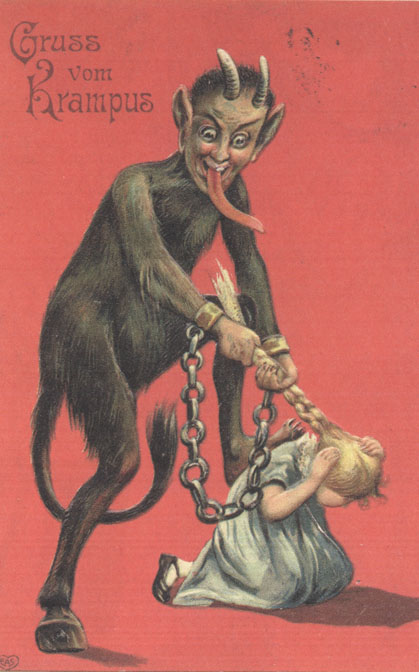
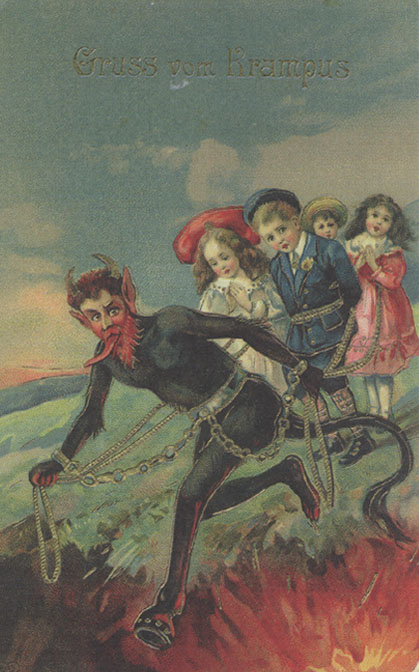
Whilst many of these other Christmas characters peaked during the fifteenth and sixteenth centuries, interest in and enthusiasm for the Krampus seems to have grown over time and the Krampusnacht remains popular today.  The nineteenth-century invention of Christmas cards saw an explosion of Christmas images of the Krampus sent around the world. The images were generally intended to be comical and something about the mischievousness and malevolence of the character clearly appealed, for Krampus cards were extremely popular. One card shows him grabbing a girl by the pigtails trying to pull her hair out.  Another sees him in a motor car stealing children.  In yet another card he is dragging a group of children off the edge of a cliff, beating children or driving off in a cart with a child in a sack on his back. Yet another card shows a group of children opening a box wrapped with shiny Christmas paper only to find the Krampus hiding inside waiting for them.

Devil_55Devil_109Devil_11

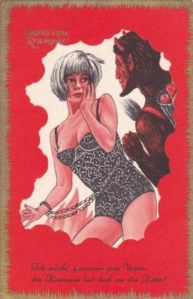
Some of the cards have a clear sexual twist. The Krampus is sometimes seen romancing attractive ladies and a couple of cards even show gigantic female Krampusse – far more woman than Krampus – chasing after adult men or carrying them away in her sack. This sexual theme for the Krampus would expand hugely after the sexual liberation in the 1960s, when cards often showed the fierce demonic figure invading the bedrooms of scantily clad women to beat them with his birch rod.

$(KGrHqVHJFQFIhlF0332BSPOfglWWw~~60_12

For the most part, however, the Krampus remains a source of terror.  The Krampusnacht continues today and is as popular as ever and, whilst it is slightly more sanitised than its anarchic Medieval peak, it still makes for a surreal and terrifying experience.

Visit here for some more absolutely incredible Krampus images.*

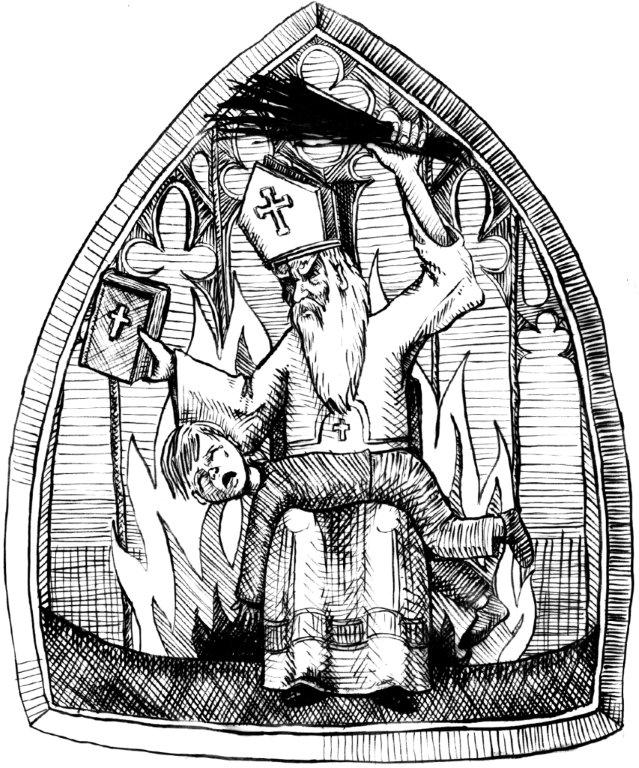
“Bad Santas and Other Creepy Christmas” by Paul Hawkins is published by Simon & Schuster and out now.  The Krampus image in the picture is by Mel Four and taken from the book.  The other Krampus pictures are from vintagepostcards and are mostly taken from Krampus.com

*(genuinely – it’s a link to the Atlantic and not affiliated to me in anyway!)

Leave a comment

Filed under Uncategorized

“Bad Santas…” Advent Calendar: December 4 – Saturnalia

Saturnalia was a Roman midwinter festival that involved the usual social rules being inverted. Social hierarchies were forgotten and people of all classes mingled together as equals. Gambling (usually illegal in Roman society) was permitted and the masters would give their slaves a banquet. The streets were full of singing, partying, Saturnalia greetings and novelty gifts. In later periods of Saturnalia, a slave or person of low social status was appointed the king of festivities. He was free to order people to do as he pleased and they had to obey. This could be seen as a clear predecessor to Medieval England’s Lord of Misrule, which also involved a common townsperson being given the power of a King.

As the Greek writer Lucian of Samosota put it in around ad 150, becoming the king of the festivities meant that ‘you can not only escape silly orders but can give them yourself, telling one man to shout out something disgraceful about himself, another to dance naked, pick up the flute-girl and carry her three times around the house’.

“Bad Santas and Other Creepy Christmas Characters” by Paul Hawkins is published by Simon & Schuster and available now. 

Leave a comment

Filed under Bad Santas Advent Calendar

“Bad Santas…” Advent Calendar – December 3 – “The Boy Bishop”

boy bishop - salisbury

All across western Europe, cathedrals would elect a boy bishop. His role was pretty much exactly what the name suggests. He was a pubescent choirboy who was elected at the beginning of December and then dressed in full bishop’s robes, mitre and crosier. He acted as the head of the Church from 6 December until 28 December. He performed the role of a priest, took all services apart from Mass and was free to direct church proceedings and appoint other choristers to act as his canons. The boy bishop was not universally popular – largely because traditionalists felt that the practice of having a small boy pretend to be a bishop undermined the solemnity of the Church.

There were practical problems too. The congregation did not seem to take the boy bishop very seriously and members of the congregation would throw things at him or pull pranks to disrupt the services. Occasionally the boy bishops took themselves far too seriously and houses near the church would suddenly be confronted with a menacing gang of choirboys dressed as bishops and canons demanding the householders hand over money to absolve their sins!

“Bad Santas and Other Creepy Christmas Characters” by Paul Hawkins is available now and published by Simon & Schuster.

Image taken from http://chrismologist.blogspot.co.uk/2011/04/saint-nicholas-and-boy-bishops-of.html

Leave a comment

Filed under Bad Santas Advent Calendar

“Bad Santas…” Advent Calendar – December 2: The Kallikantzaroi

Kallikazantoroi


In Greece those twelve days of Christmas are also the time of the Kallikantzoroi.   The Kallikantzoroi spent the rest of the year underground and Greek tradition went that there was a tree of life that ran right through the Earth and acted as a scaffold to hold it in place. Without the tree, the Earth would simply collapse in on itself. The Kallikantzoroi are quite keen on world destruction and spend January to December sawing through the tree, hoping to snap it in half and bring down the Earth. By the end of the year only the slenderest of threads holds the tree together and the world is set to end at any second. But, just as the Kallikantzoroi are about to make the final cut, Christmas arrives and they are summoned above ground. By the time they return in early January, the tree has regrown and they have to start all over again.

Overground, their actions are sometimes mischievous – they play pranks, steal things or sow discord amongst communities. Other times they might overturn furniture and destroy possessions or they might move on to the inhabitants – beating people savagely or even aping Perchta and ripping out intestines.

What’s more, parents knew that any baby born over the twelve days of Christmas might be spirited away during the night and fated to spend eternity as one of these strange, sinister creatures (or at least turning into one for twelve nights each year).   Binding newborn babies with tresses of straw and garlic would ensure the creatures could not get near them.

But how did you stop a Kallikantzoroi from getting near your house in the first place?  One thing the Kallikantzoroi could not do was to count beyond two – the number three was seen as a holy number by the Greeks.  The creatures would count ‘one, two’ and get confused, lose count and have to start again. The Kallikantzoroi were easy to trick by simply placing a colander outside the front door. The creatures would feel compelled to count the holes and, of course, would not be able to do so. Their confusion and failure to count would keep them occupied until sunrise – at which point the household would be safe until darkness fell again.

“Bad Santas and Other Creepy Christmas Characters” is published by Simon & Schuster and available now.

Image by Mel Four.

Leave a comment

Filed under Bad Santas Advent Calendar

“Bad Santas….” Advent Calendar – December 1: Frau Perchta

Frau Perchta

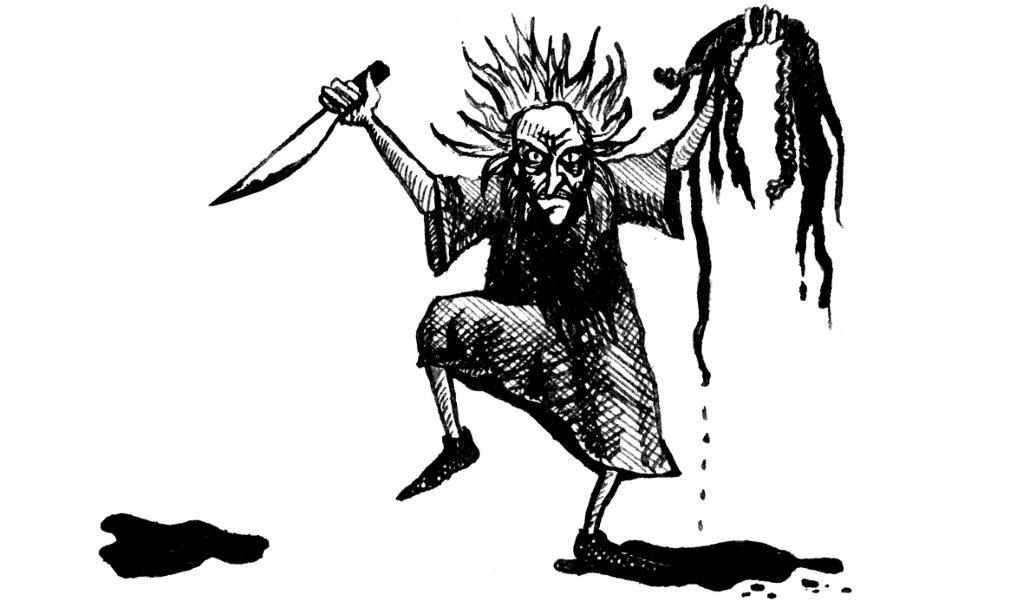
Frau Perchta was a demonic witch who stalked Medievel Central Europe punishing anyone who dared to displease her.

In Tyrol, Frau Perchta appeared as a mischievous, dishevelled old woman. In other places her appearance could depend on how you perceived her and whether you had pleased her. If you were faithful, obedient and observed her rituals, Perchta would appear to you as a staggeringly attractive woman of divine beauty. If you angered her she would appear as a demonic, horned monster with a ferocious bloodlust.

Her most common form of attack was to sneak into your house in the dead of night during the winter and creep up to your room where you were sleeping. The goddess would then take out a knife and, whilst you slept unaware, she would slit your stomach open and remove your innards and your intestines. She’d then replace those innards with pebbles and straw and sew you back up so whoever discovered your corpse the next morning would find absolutely no signs of physical damage. In the days before regular autopsies, nobody would ever prove that you had not simply and peacefully passed away in your sleep.

“Bad Santas and Other Creepy Christmas Characters” by Paul Hawkins is available now and published by Simon & Schuster.

The illustration is by Mel Four and is taken from the book.

6 Comments

Filed under Bad Santas Advent Calendar